When it comes to flexible pouch packaging, most conversations focus on print quality, material selection, or sustainability. But one of the most impactful decisions a converter can make happens at the very end of the production process: the finishing cut.
At Lauterbach Group, we choose to use a double cut finish on our pouches. It’s a premium process step—one that not every converter employs—and it makes a visible difference in how your product looks on shelf, and a meaningful difference in consistency, defect rates, and perceived brand value. For us, it’s not an upsell. It’s the standard we hold ourselves to.
Here’s what it means, why it matters, and what you should look for in a flexible packaging partner.
What Is a Double Cut Finish?
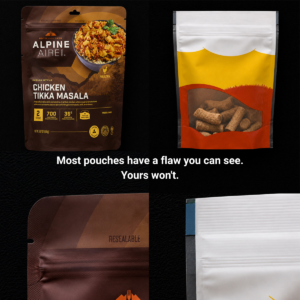
A double cut finish means that both sides of the pouch are trimmed after printing and sealing, rather than relying on a single pass or pre-registered die cut. In standard flexographic printing, plates wrap around a cylinder. Where a plate begins and ends, there’s a small gap—called a plate gap—that can create a faint seam or line in the printed artwork. With a single cut process, that gap can land squarely on the face of the finished pouch. Double cutting removes it entirely, leaving a clean, continuous graphic on every unit.
1. Eliminates Visible Plate Gaps
The plate gap isn’t a defect, it’s an inherent characteristic of flexographic printing. But when it shows up on the face of a finished pouch, it registers immediately. Consumers and retail buyers notice even when they can’t name what they’re seeing. It reads as inconsistency, and inconsistency reads as lower quality.
By trimming after printing, double cutting eliminates the gap before the pouch ever reaches a shelf. The finished face is clean and uninterrupted—top to bottom, unit to unit.
Result: A seamless, high-end appearance with no visible print interruptions.
2. Improves Shelf Appeal and Brand Perception
Consumers equate visual consistency with product quality. Even a subtle plate gap can register subconsciously as “lower quality” or “off-brand.” It’s not always something a shopper can articulate — but it influences buying decisions.
Double cutting ensures:
- Perfect graphic centering on the pouch face
- Clean, sharp edges on every unit
- Consistent pouch dimensions across the entire run
Result: Better shelf presence and stronger perceived brand value for your product.
3. Tighter Registration and Run Consistency
Flexographic printing can have slight variation in repeat length and registration — even on well-maintained equipment. This is a normal characteristic of the process, not a defect.
But without double cutting, that variation gets locked into the finished pouch. Double cutting compensates by trimming after printing, rather than relying on exact repeat alignment to determine where the graphic lands.
Result: More uniform pouches across the entire production run, with meaningfully reduced variability.
4. Reduces Customer Complaints and Rework
Plate gap visibility is one of the most common rejection points for brand owners reviewing flexible packaging. When it’s present, the downstream costs add up quickly:
- Increased rejection at receiving inspection
- Rework, credits, or reprints
- Delays that ripple into inventory and launch timelines
Double cutting removes this as a variable. The trim step catches what the press run can’t always guarantee.
Result: Fewer defects reaching customers and lower total cost of quality over time.
5. Enables Premium Positioning
Many brands in food, pet care, supplements, and specialty retail expect what buyers and brand managers call “retail-ready perfection.” They’re comparing your flexible pouch to what comes off a rotogravure press—a process known for exceptional print consistency and clean edges.
Double cut finishing closes that gap. It helps converters deliver:
- Higher-end packaging at flexographic economics
- Finishes comparable in appearance to gravure quality
- A product that competes on shelf against brands spending far more on packaging
Result: The opportunity to justify a premium price point and win higher-value brand business.
The Bottom Line
A double cut finish is a small process step with a large impact on perceived quality. It:
- Eliminates plate gap visibility on the finished pouch face
- Enhances visual quality and graphic continuity
- Improves consistency across long production runs
- Reduces the risk of defects and customer rejections
- Adds measurable brand value on shelf
At Lauterbach Group, double cut finishing is part of how we deliver flexible packaging that performs as well as it looks. If you’re evaluating pouch suppliers or asking why your current packaging doesn’t look the way you expected, this is often one of the first questions worth asking.
Ready to see the difference? Contact Lauterbach Group to discuss your next flexible packaging project.